Sunday, December 7, 2014

[Literature Review] Spatial Transfiguration: Anamorphic Mixed-Reality in the Virtual Reality Panorama by CA Brisbin - ‎2007

This literature shared the similar idea with Oliver Grau's Virtual Art (2003) which discussed the concept of visual representation technique from Art History painters and how technology reference from those techniques and build upon them immersive visual experience.

Compared to Grau, Brisbin's way of structuring his argument points are clearer. While Virtual Art served as a background reading for a beginner to build fundamental knowledge of Art History and Virtual Art, this paper has a specific and well-defined aim of suggesting development path and concern in QuickTime Virtual Reality panorama by Ken Turkowski and the Apple Advanced Technology Group during the late 1980s. 

In his 13 pages long article, he provide very good and clear paragraph title and lead reader from one section to another. His constant focus of discussing the picture plane, visual representation techniques, spatial geometry and observer view, enable reader to pay close attention to the discussion he made.

Besides specifying some deficiency among the three basic construction of geometries in VR, the cylinder, cube, and sphere, Brisbin also point out how artists in the Renaissance and the baroque manage to create effective spatial illusion in their artworks. He recommended some of the immersion exemplified by Holbein’s Ambassadors or Pozzo’s Sant ‘Ignazio nave painting. In all three VR panoramic typologies, the observed image that tries to create spatial illusion to the viewer still has a relative constant distance, especially in the cube construction. 

In his conclusion, he summarized his discussion points and suggested that all the potential development will give hope to the beginning of a new form of mixed-reality image technology which transfigures the observer’s relationship to images in/within space. 

Tuesday, November 25, 2014

Ethical Concerns - Minimal ethical issues

In this research, the aim is to appreciate and learn the visual technique used to create immersive space from the classical painting/art in Renaissance period, then apply into immersive digital design solution.

With this aim as focus, the research subjects will be artworks and theories applied in the work. There's no human subject or organisation used in the research. Among the types of data collected are photographic image, music video, illusion art visual techniques tutorial (sketches/guideline) in image and video, recorded seminar video, and article url. Most of the subjects are content online that allow public viewing, with proper citation and link to the original source, there shall be no major ethical issue occurred.

The research does not specifically involve children. The audience that benefit from the research will be digital artists, digital media companies, and media schools. The activity of this research involve reading, examining and evaluating theories and discipline involved in illusion art creation in the classical painting as well as digital media technology. There will be no illegal activity involved.


Wednesday, November 19, 2014

[Literature Review] Virtual Art: From Illusion to Immersion - Chapter 4

Oliver Grau, Massachusetts: MIT Press, 2003. 416 pages. ISBN: 0-262-072416. £29.95 (Hardback)

Chapter 4. Intermedia Stages of Virtual Reality in the. Twentieth Century: Art as Inspiration of Evolving. Media.

In his book, Grau investigate the topic of illusion and immersion from the perspective of his Art History background. Particularly in this chapter, he line up the phases of illusion techniques used in different media to represent our perceptions of reality. He associate the idea of Virtual Reality development with the experiment of Claude Monet’s rendition of Water Lilies, a panorama experience from the static world of painted representation. The main objective of immersive illusion in this case, will be to reduce the distance between image and observer. Grau then aligned the following media examples in the chapter with the same objective, with further explanation of how computer generated realities create "the union of stage and audience".

Besides, he also bring into focus the impact of created impressions of space and depth through technologies including: cinema, Cinéorama, 3D film, Imax, and the use of HMD in early computer generated virtual reality of the 1960s.

Some reviewers mentioned that his did not make consistent argument about his understanding of immersion in the book. However, as educators seeking to inspire media design students, this chapter provide a good introduction to the constant development of artist in creating immersive experience through art and technology.

Other links:
https://blackboard.lincoln.ac.uk/bbcswebdav/users/dmeyerdinkgrafe/archive/grau.html
http://kairos.technorhetoric.net/8.2/reviews/palmer/
http://journal.media-culture.org.au/index.php/mcjournal/article/viewArticle/744

Monday, November 10, 2014

Refined Proposal

Lessons in Immersive Space Media Experience from 2 Modern Art Masters


Introduction:

In the history of art, artists explored techniques to create engaging visual that blurred the line between real world and the painting. The introduction of perspective theory in the Renaissance, allow artists to create artworks that mimic the real world through the study of lights and shadow in creating realistic three dimensional visual. The illusion of space in painting later on developed into theatre design, architectural painting on church walls. The aim of creating artwork that engage viewer’s attention remains in contemporary art today. With the accessibility of technology today, artists inspired by the illusion techniques in the history of art continue exploring perspective theory, through creative camera angle, computerised graphic images and projected large-scale visual on 3D or architectural surfaces, to create immersive space in relation to the viewer.
(130 words)


Research Question:

Explore illusionism in the history of art, through classical painting.

Compare and contrast the application of Trompe-l’oeil and forced perspective techniques in spatial design in classical painting and contemporary media art.

Examine artworks from Modern Art Artists for example Samuel van Hoogstraten - ‘peepshow boxes’ and M. C. Escher’s Relativity to find out effective techniques used to create immersive space in the work.
(63 words)


Research Topic

This paper will outline the characteristics of illusionism. The attempt to make visual seemingly extend the three-dimensional space from the point of view of the spectator, and in architecture, the attempt to enhance the dimension of space in some way will be discussed. By reviewing techniques of two modern art masters in creating realistic and immersive space in their work, the paper attempts to find out the effective methods used in the modern art and suggest potential ways of application in today’s media technology experience.
(85 words)


Scope of Enquiry

As the area of research in illusionism is too wide, this paper focuses on the development of perspective theory in art history. The discussion outline the expension of visual presentation through illusionism to create immersive viewer experience. Case studies discussed in the essay will range from classical painting to centemporary time-based media. Other than perspective theory in the modern art, this paper will also cover the relationship of immersive space media experience through mix reality and virtual reality.
(78 words)


Relevance to the Personal Practice

With her interest in visual communication through spatial interaction design, the author has strong curiosity in the finding out the early exploration of artistic spatial design through painting in churches, architecture design of theatre, and stage design. By understanding the visual design through the use of perspective in relation to the spectator’s point of view, it’ll allow the author to extend the knowledge into digital media practices to create engaging experience in as a media artist.
(76 words)


Feasibility

The feasibility of this enquiry is moderate. With the theories introduced in previous semester, immersion theory, and perspective will be used to explore the concept of immersive and realistic digital media experience. Type of data required in this research is easily accessible through books, journals and articles online or offline. As the topic involve discussion on famous modern artists, information is available in photographic images, artwork images video footages and reviews. Besides that, there are also digital artists, psychologists and educational institution discussing the similar topic in my research scope. So the source of research reading will be wide range with variety.
(102 words)


Timeline

July
week 9 - Tutorial session
week 10 - Proposal submission

August
week 11 - Feedback from tutor
week 12 - Reading main reference
week 13 - Blog entry

September
semester break

October
semester break

November
week 2 - Organising reading map
week 3 - Reading & blog entries
week 4 - Literature review

December
week 5 - 1st draft feedback
week 6 - Blog submission
week 7 - Reading & referencing

January
week 10 - 2nd draft feedback

February
week 11 - Refine essay writing, spell check
week 12 - Sharing session
week 13 - Submission

March
week 14 - Feedback from tutor

(88 words)


Bibliography:

Brisbin, C. (2007). Spatial transfiguration: anamorphic mixed-reality in the Virtual Reality panorama. [online] Available at: http://eprints.qut.edu.au/12274/.
This journal discuss Spatial illusion and immersion achieved in Renaissance painting through the manipulation of linear perspective’s pictorial conventions and painterly technique that later on developed into virtual reality.

Chambers, K. (1991). Trompe l'oeil at home. 1st ed. New York: Rizzoli.
This book shows how rooms can be magically transformed through tromp-l'oeil murals, objects, paintings and fabrics, as well as with painted faux finishes that dazzle and beguile the viewer.

Escher, M. (1992). The graphic work. 1st ed. Köln: Taschen.
This book archive the collection of Escher work with description. It serve as a guide for me to understand some of the famous illusionism work.

Grau, O. (2003). Virtual art. 1st ed. Cambridge, Mass.: MIT Press.
In this book, Oliver Grau shows how virtual art fits into the art history of illusion and immersion. He describes the metamorphosis of the concepts of art and the image and relates those concepts to interactive art, interface design, agents, telepresence, and image evolution.

Journal.utarts.com, (2006). Picturing the Mind's Eye. [online] Available at: http://journal.utarts.com/articles.php?id=4&type=paper [Accessed 17 Jul. 2014].
This online article explains geometric optical laws of vision and how it creates illusion in viewer perception.

Op-art.co.uk, (2014). Op Art History Part 1 - History of Perspective | Op-art.co.uk | Op-Art.co.uk. [online] Available at: http://www.op-art.co.uk/history/perspective/ [Accessed 17 Jul. 2014].
This is a specialized Optical Illusion art website that compile opt art in different types of media.

Thursday, August 7, 2014

Impossible Photography Ted Talk


This sharing of the photographer, Erik Johansson, on how he create illusion in photography. Instead of capturing real moments in life, Erik's works focus more on capturing an IDEA. And the idea is communicated through realistic photos that can't be found in life, yet contain some believable elements in them. He shared his observation of reality, and taking different pieces of reality, with planning and understanding of lights and perspective, he made stunning impossible photography.

Artwork Name: Common sense crossing

The picture above creatively captured the isometrical view of the cross road. The composition of the picture is in perfect symmetrical balance. With careful planning of perspective and objects lighting, the photo appeared to be normal at the first glance, and it engage audience to think when some of the elements in the picture doesn't seem normal.


Another example of combining realities

Another tip Erik shared, make it impossible to
find out where is the beginning and where is the
end of the combining

Just like Rob Gonsalves' magic realism artwork, Erik captured the essence of visual illusion in photography and make realistic artwork that engage observers attention.


Wednesday, July 23, 2014

Optical Illusion MV: The Writing's on The Wall


OK GO, the alternative band has recently produced a Optical Illusion music video for the song The Writing's on The Wall. This video is a one-take video that pan and move around the warehouse with different sets of illusion installation. Like many optical illusion art work, the art work are created targeting specific way of viewing to achieve the best illusion effect. Through the way singers interacting in the illusion scene, and moving the camera (mounted in a stabilizing Fig Rig frame) from one illusion scene to another, it gives user just enough time to grab the understanding of the illusion from station to station.

The mv applied various illusion technqiues like perspective theory, mirror reflections, forced perspective and black and white op art.


While playing with the forced perspective in this wall scene, the singer walk from distance approaching the camera (viewer) with basketballs on bouncing toward the camera. This way, the viewer's perception toward the "flat" blue circles is constantly changing as the relational depth of view is being confused. 


The 2 pictures above show how some of the scene need to be camera-angle specific in shooting the illusion scene.

Thursday, July 10, 2014

Put Together Thoughts

After spending about 7 weeks into researching optical illusion and some of its early exploration in the history of art - through painting, stage set design and architecture, I think I've got some thoughts formed in my mind.


#1 The Visual Norm
Psychologically, human brain recognises visual in very unique way. We can read foreground and background visual, finding the depth of the visual. We will also tent to fill in gaps that associate visual to the familiar object we have in our memories. We find meaning in visuals that we see.

The visual norm in this case refers to the convention of human understanding towards the meaning of visual.
Shuplyak Oleg - Self-portrait under the lime trees
The painting above smartly arrange the trees in front to create the negative space of a face. Then the position of the 2 houses is placed at the proportion of the eyes of a human face. The posture of the artist who is painting the scenery formed the nose shape. With the correct proportion and placement of irrelevant object at the right shape, our eyes naturally recognise the portrait on top of the scenery painting itself.


#2 Relative Space - that Trick of the mind
In many artwork analysis I've done, the perspective in the artwork has big impact towards the viewing experience of the audience. The vanishing point and perspective affect the horizon view and the scale of the work. It also affect the dimension of the work in relation to the audience.

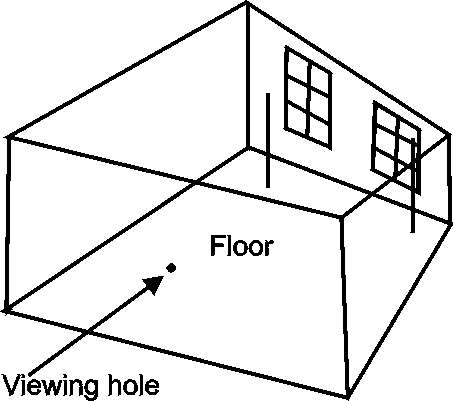
When 2 persons with similar height stand in a room that created with different ceiling height,
comparatively the person that stands at the side with lower ceiling appeared to be
taller than the other person who stands at the higher ceiling side.

http://alicook.com/blog/whats-going-on-in-this-picture


One Point Perspective - Vanishing point guideline

Sony PS3 Video Store - Realtime Projection Mapping
The projection mapping video from Sony PS3 Video Store uses one point perspective to create a forced perspective on the wall. Visually the depth of the room extended to further distance.


#3 Light & Shadow (Trompe-l'œil)
The relationship between light and shadow will affect the texture and the material of the object in drawing. The level of lights reflected on the planes, creates the illusion of different facet of the box (refer to the picture below).


Playing with light and shadow on different sizes of planes on a drawing, with perspective guided architectural drawing, illusion of emboss and deboss is created.

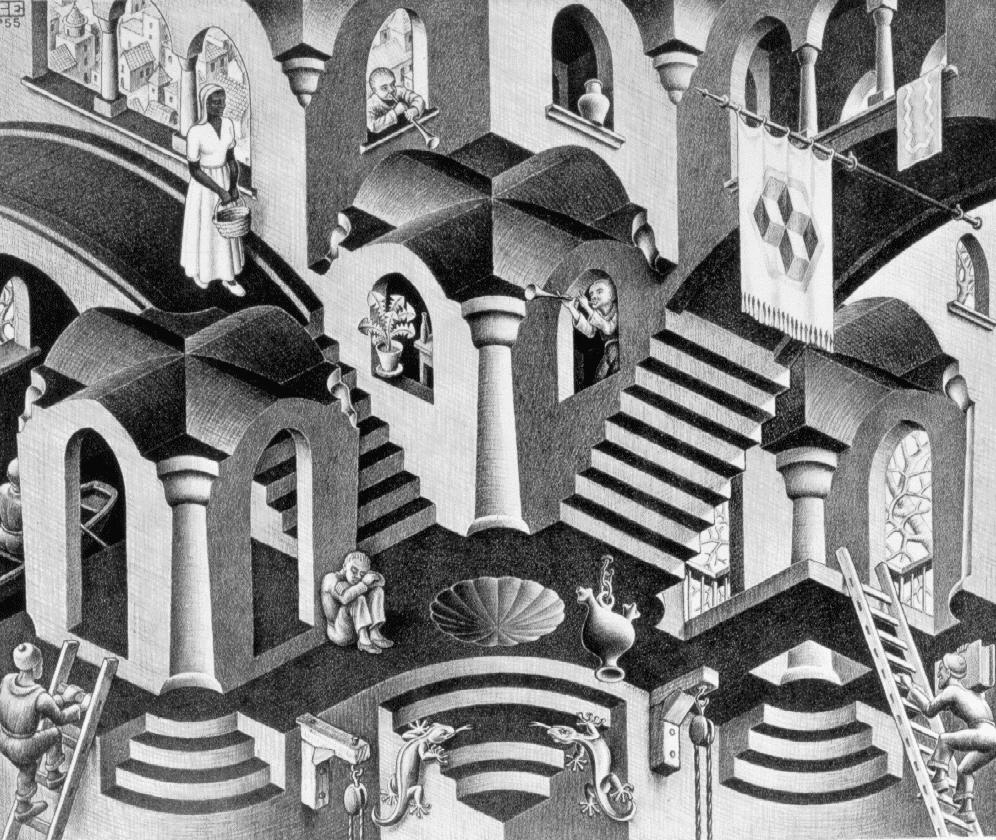
Escher's Relativity
John Lancaster defines it as follows in 1973: Optical art is a method of painting concerning the interaction between illusion and picture plane, between understanding and seeing
Ballpoint Drawing by MATHEW BORRETT
The artwork from Mathew Borrett above uses 2 point perspective to allow more facet of planes and dimension in the drawing.


Tuesday, July 8, 2014

Trompe-l'œil & Forced Perspective

Trompe-l'œil (French for deceive the eye) is an art technique that uses realistic imagery to create the optical illusion that the depicted objects exist in three dimensions. Forced perspective is a comparable illusion in architecture. from Wiki

https://www.altaplana.be/dossiers/darius/the_walls_of_samaris_part_2_the_trompe-d_oeil_and_you


Some of the Forced Perspective Illusion

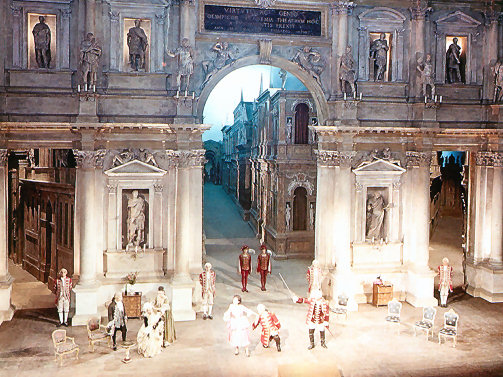
> Stage Set - Teatro Olimpico
Trompe-l'œil, in the form of "forced perspective," has long been used in
stage-theater set design, so as to create the illusion of a much deeper
space than the actual stage. A famous early example is the
Teatro Olimpico in Vicenza, with Vincenzo Scamozzi's seven
forced-perspective "streets" (1585), which appear to recede into the distance.


Illusion of scene transition


The Illusion of Scene Transition make use of perspective theory in large scale visual "realities" together with the actors/ actresses on stage, created an immersive experience to the observer in the audience seat. The mathematic calculation of perspective on the triangle surface allow quick transition during the play. 


> Film Making - Create a HOBBIT-sized Illusion

Forced Perspective technique 


In order to create illusion of dwarf and giant tall wizard with normal human, the actors are arranged in different distance with the camera. According to the theory of perspective, the same items will looks bigger when it's nearer to the observer, and it appeared to be smaller when it's placed in further distance to the observer. In set design, props that used by the giant will needs to be smaller than the usual size we have. For example the cup on the wizard hand above, is a smaller version of the normal cup to create illusion of a giant. While the dwarf character above, (seating further away from the camera) has a plate the is larger than usual plate size so that when it's place at the further distance, it'll still looks like it's at the same distance with the wizard.  


> Wall Paint - Trompe L'Oeil PRACTICAL.


Conclusion
With the collection of techniques used in variety art forms like Stage Performance, Interior Architecture, Filming and Painting, the idea of illusion share some of the similar points.

When observer maintain a distance with the artifact, the use of perspective techniques, lights and shadow position, camera angle will affect the physiological aspects of optical perception.


The history of Cutting - The Soviet Montage Theory


This short video gave me a quick revision of how storytelling in motion picture developed from showing everyday life action to an accidental discovery of "magic" through cut scene. Actor can be none existence at the first second and suddenly appear in the next second.

Understanding this may contribute to my development of video storyboard of the optical illusion projection mapping content.

Thursday, June 19, 2014

Application of Optical Illusion Collections

I came across an amazing documentation of Illusion in Art from Dark Roasted Blend. The collection is pretty extensive. This link helped me to expend my illusion art knowledge from painting, landscape photography, sculptures, architecture, abstract geometrical graphic to advertising. The series of posts enable to me pick up some of the techniques used in illusion art.

Inspired by the author, I make a post with some other collection of Illusion Art in commercial design:
Absolut Vodka is every where!
Just like many of the illusion art painting, Absolut Vodka adopted the visual illusion technique by embedding Absolut Vodka bottle all around the drawing. While the city scene looks believable at one glance, some usual structure just looks a little abnormal when observer pay attention to the details on the drawings. The artist of this poster has embedded Absolut Vodka bottle shape in to many form of the visual elements in the city. One of the powerful thing illusion art does, is that it draws observer's attention to find out the 2nd layer meaning in the artwork. That way, observer felt rewarded to be able to "extra" content from the stagnant piece of work. 

The shape of Absolut Vodka bottle in this painting can be "seen" at the zebra crossing, water foundant, building structure, top of the building, alien's spaceship, banner behind the air plane and etc...


Club Med - look for the relaxing face
Compared to Absolut Vodka Print Ad above, this ad apply the similar deception technique. By placing visual hint of human face, though the photos are showing a landscape or a scenery of a vacation spot, the mind connected the visual and allow viewer to see human face in the photo. The visual deception as Gestalt psychological and some of the cognitive neuroscientific point of view suggest, make us connect the missing information in what our eyes see, and form an understanding in our mind.

Below are some other collections of optical illusion application:


Monday, June 16, 2014

Optical Illusions Happen at the Intersection of Art and Science.

The first Artist I came across in the art history is Maurits Cornelis Escher (1898-1972). M. C. Escheris a famous Graphic Artist. His artwork show's great exploration of optical illusion. Some of his work explore "Impossiple Construction", and some explore "Metamorphosis".

I would day that he is very sharp in capturing the shape and form of the graphic where same figurative graphic can be arranged together and form patterns. He can considered as a pattern designer to me.

Below are some of his famous work:
Relativity - 1953 Lithograph

Drawing Hands - 1948 Lithograph


Day and Night - 1938 Woodcut in black and grey, printed from 2 blocks.

In most of the art work, he showed good sense of depth and height, able to capture the vision of far and near in his artwork. Some times, the perspective in the artwork was not meant to set the viewer in a secure, measurable space. It was a means of distorting the view and fooling the eye.

Some of the comparison of inspiration his work has towards the digital media today. 

The illusion of depth and height, and the character could walk on different surface
of the game ui shows it's influence from Escheris's work


The use of mirror and the fish eye view created the illusion of space in these artworks


Monument Valley - iOS Game


First Tutorial Session

Above is some of the points recorded in the tutorial session

Potential Direction I could think of managing my research and my project
Some of the notes for further research in the history of art:
- Explores Optical Art/ Visual Illusion in the fine art area
- Explore the theatre tricks > stage design, illusion, make illusion of space (bigger space/thunder)
                                           > magic trick
- I can also choose to explore static optical illusion (printed) or moving optical illusion (stage)
- The consideration of visual, is it figurative or is it abstract geometrical graphic?

Level 6 Research Starts Here

To mark a new beginning of the research and thoughts chapter, I'll like to post my idea map that marks some of my past semester knowledge in contextual study in BIMD program.


This cultural/ theories map is created based on my interest or a curiosity in the power of art and design.
I sometimes wonder at the creativity artists and designer had in seeing wonders in a piece of blank paper. For today's artists, we see endless possibilities in a flat pixel screen.

We can make a universe of 3D game world bring player back to a medieval world. Creating a carousel navigation to display album covers in MP3 player software, table top layout design and many other possibilities through visual communication techniques has enrich the visual experience of a computer user. Sometimes just distorting a rectangle shape could already create a depth of view, plus the control of lighting, colour and composition, the world become more and more believable.

The trigger point that makes me feel super amaze is when I see projection mapping project that pushing the canvas from computer screen or theatre projection to a building. By playing with the architecture structure, re-look into the same old building with a new and trendy visual approach, mixing 3D, animation, projector technology, the art piece create impact in the way message is delivered.

Particularly in the visual exploration of the projected surface, the architecture and how projection visual display the 3D illusion is one of the major clue to effective or realistic projection mapping.

So in the further exploration of the visual techniques, the potential audience/ viewer experience will be analysed and explored in this project. It'll be more towards art and aesthetic experience study.  

I started the research by reviewing some of the theories I've learnt in the past semesters. There are also some that I found from online reading.

Thursday, June 12, 2014

Page Break

This post mark and the chapter break from level 5 to level 6