 |
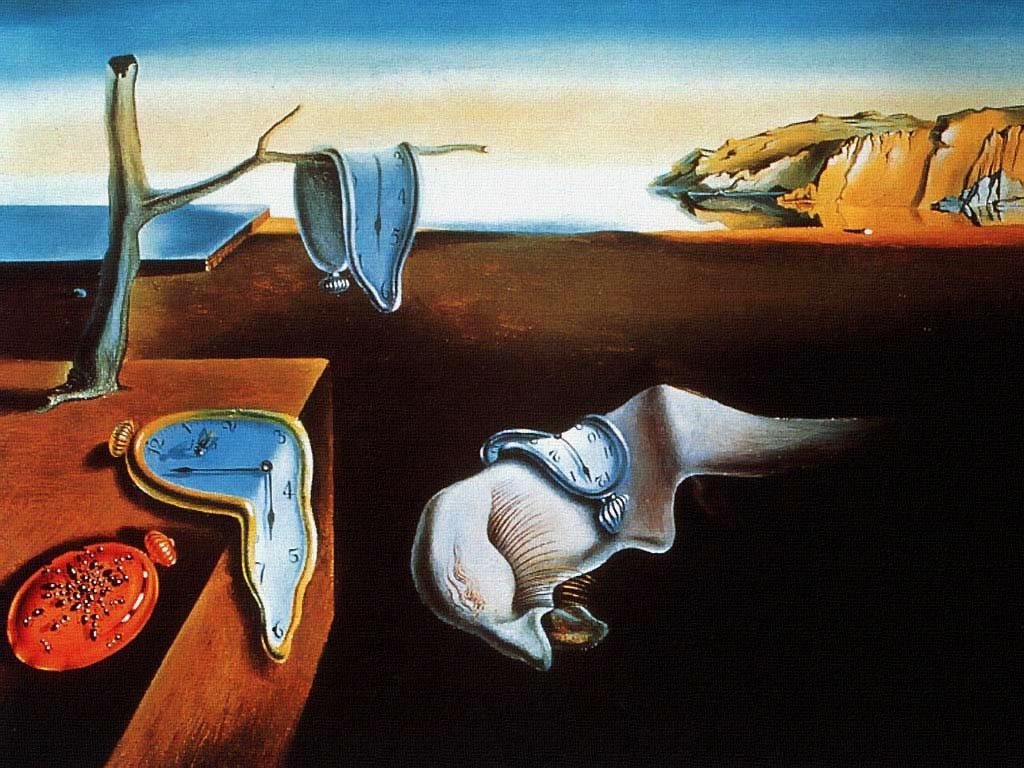
| The Persistence of Memory by Salvador Dalí |
Paranoid Critical
In order for the artist to see the world differently to create his "dream" work, Salvador Dali developed a method to allow himself to enter into a Paranoid state that allow him to perceive the reality through subconscious mind. While entering into that mode, he still manage to critically record his illusion vision onto canvas clearly. I believe this is one of the reason he produces many master pieces of surrealism work. Besides that, I also agreed with the the way Dali explains about how subconscious and surrealism can be accepted during modern art period as quoted below:
“The subconscious has a symbolic language that is truly a universal language, for it speaks with the vocabulary of the great vital constants, sexual instinct, feeling of death, physical notion of the enigma of space—these vital constants are universally echoed in every human. To understand an aesthetic picture, training in the appreciation is necessary, cultural and intellectual preparation. For Surrealism the only re requisite is a receptive and intuitive human being.”
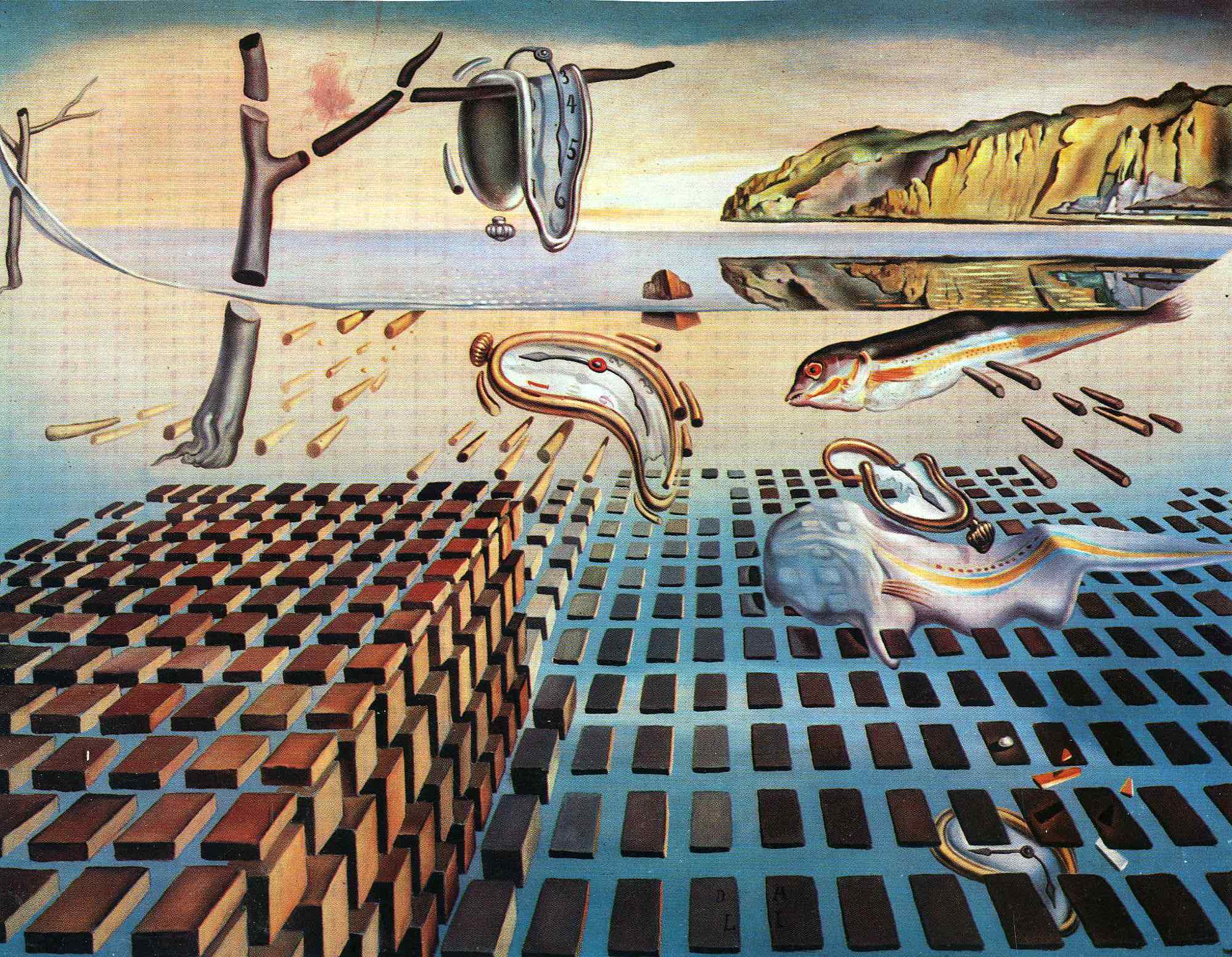 |
| The Disintegration of the Persistence of Memory |
Nuclear Mystical
Influenced by the scientific and philosophical concepts that dealing with consciousness, at this stage of Dali's work, he injected the idea of Quantum Mysticism into his works after WWII. At this time of his life, religion also played a role in his life. Above is his work The Disintegration of the Persistence of Memory. Compared to the original work of The Persistence of Memory, this version has more details like bricks and horns. The sense of material is stronger.
Some of the philosophical claims of Quantum Mysticism include beliefs such as “There is no observer separate from reality and no separate reality from the observer.” Others include:
- The body is only perceived as solid matter, in essence made of energy and information.
- The mind and body are indivisible entities.
- Perception of reality is a learned action.
- The body transforms along with changing thoughts.
- Somatic reactions of the body are a product of awareness.
- There is a fundamental consciousness or intelligence that connects everyone.
- Time is a human perception, not reality.
Most of Dali's work are expressed through the presentation of consciousness and how it perceive reality. Before doing this research, I only look at the drawing at the object without the contextual understand of this part of Modernism period. Now that I learned this, I think I helps me to make better exploration into illusion art

Above are some of the quotes by Dali that I screen capture as a reference.
Other Reading:
http://www.theartstory.org/artist-dali-salvador.htm
http://www.dali-interart.be/pdf/DALI_SYMBOLS.pdf
http://samui-art-gallery.com/top-10-most-famous-dali-paintings/
http://www.slideshare.net/ljohnson60/surrealism-ppt?related=1
http://www.moodbook.com/history/modernism/salvador-dali.html
http://www.jstor.org/stable/425884
http://www.tufts.edu/programs/mma/fah188/clifford/Subsections/NuclearMysticism/nuclearmysticism.html