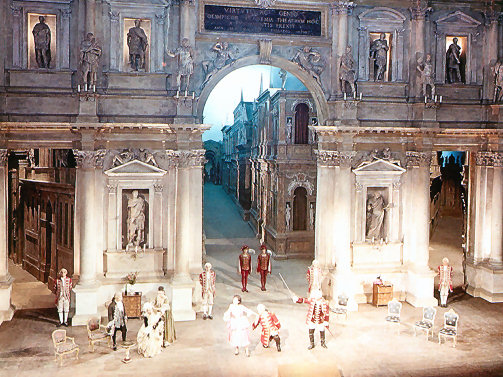
After spending about 7 weeks into researching optical illusion and some of its early exploration in the history of art - through painting, stage set design and architecture, I think I've got some thoughts formed in my mind.
#1 The Visual Norm
Psychologically, human brain recognises visual in very unique way. We can read foreground and background visual, finding the depth of the visual. We will also tent to fill in gaps that associate visual to the familiar object we have in our memories. We find meaning in visuals that we see.
The visual norm in this case refers to the convention of human understanding towards the meaning of visual.
 |
| Shuplyak Oleg - Self-portrait under the lime trees |
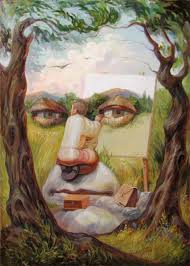
The painting above smartly arrange the trees in front to create the negative space of a face. Then the position of the 2 houses is placed at the proportion of the eyes of a human face. The posture of the artist who is painting the scenery formed the nose shape. With the correct proportion and placement of irrelevant object at the right shape, our eyes naturally recognise the portrait on top of the scenery painting itself.
#2 Relative Space - that Trick of the mind
In many artwork analysis I've done, the perspective in the artwork has big impact towards the viewing experience of the audience. The vanishing point and perspective affect the horizon view and the scale of the work. It also affect the dimension of the work in relation to the audience.
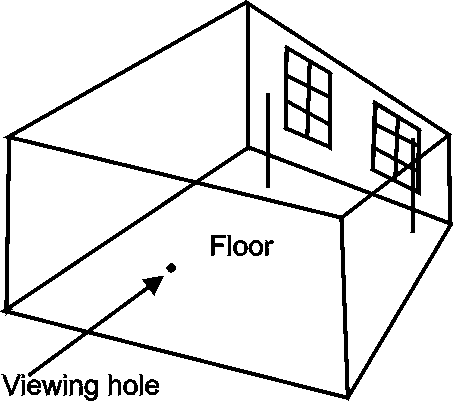 |
When 2 persons with similar height stand in a room that created with different ceiling height,
comparatively the person that stands at the side with lower ceiling appeared to be
taller than the other person who stands at the higher ceiling side. |
 |
One Point Perspective - Vanishing point guideline |
 |
| Sony PS3 Video Store - Realtime Projection Mapping |
The projection mapping video from Sony PS3 Video Store uses one point perspective to create a forced perspective on the wall. Visually the depth of the room extended to further distance.
#3 Light & Shadow (Trompe-l'œil)
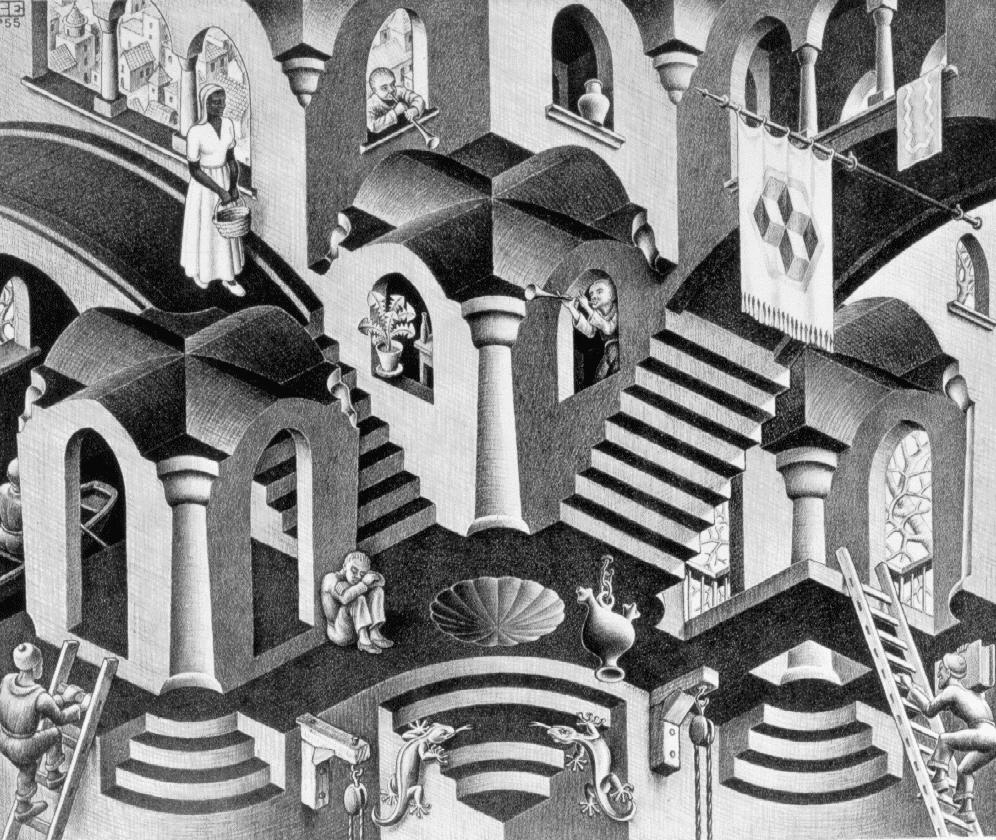
The relationship between light and shadow will affect the texture and the material of the object in drawing. The level of lights reflected on the planes, creates the illusion of different facet of the box (refer to the picture below).
Playing with light and shadow on different sizes of planes on a drawing, with perspective guided architectural drawing, illusion of emboss and deboss is created.
 |
| Escher's Relativity |
John Lancaster defines it as follows in 1973: Optical art is a method of painting concerning the interaction between illusion and picture plane, between understanding and seeing
The artwork from Mathew Borrett above uses 2 point perspective to allow more facet of planes and dimension in the drawing.