Reading source:
http://www.webexhibits.org/sciartperspective/raphaelperspective1.html
http://www.webexhibits.org/arrowintheeye/brunelleschi1.html
http://www.webexhibits.org/sciartperspective/perspective1.html
https://www.dartmouth.edu/~matc/math5.geometry/unit11/unit11.html#reading
Before the an accurate way of calculating depth is proven by Filippo Brunellesci around 1425, painters were struggling to create realistic environment in their paintings. None can escape from the criticism of inaccurate perspective in their artwork. Being an architect and engineer, Brunellesci discovered the laws of one point perspective or linear perspective that creates accurate illusion of depth as how human eyes see the environment before us.
The video above is a demonstration of how Brunellesci proved his perspective-accurate drawing of through his peep show by turning his drawing backwards from the viewer, and let the artwork face the mirror in between the real world scene and the drawing. The reflection of the drawing falls on the mirror matches the real world angle of the viewers point of view.
This demonstration has caused a major impact to the artworks created during the Renaissance period. The basic principles of one-point-perspective includes a horizon line across the canvas which resembled viewer's point of view. A vanishing point where objects in the distance place will converge at one point. Every object appear in the scene will have their horizontal plane parallel to the horizon line and the side of the horizontal plane will connect to the vanishing point creating a distortion of the shape due to the depth of view in the scene. (refer to Picture 1)
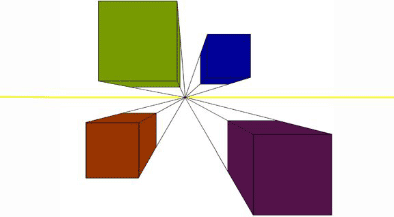 |
| Picture 1. Following the laws of One-point-perspective creates the illusion of depth in a flat surface |
The video link above is a commentary mentioned how Brunellesci's perspective law impacted the Renaissance.

No comments:
Post a Comment